|
The
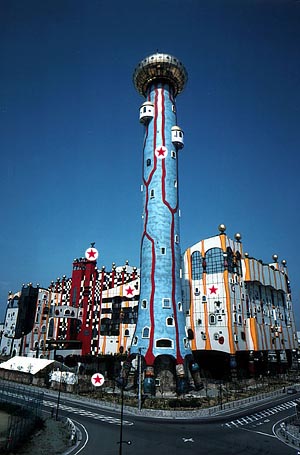
most distinctive characteristic of the plant - its unique appearance
- is the work of the Viennese artist, Friedensreich Hundertwasser.
Early on, Hundertwasser set out to integrate architectural structures
with nature, and in so doing, created a large body of work. His architecture
makes use of intentionally curved lines and irregularities, and to
avoid monotony and repetition, he relies heavily on the colors of nature, some of which are provided by live plants growing out of the exterior walls and roof of the building. Everywhere you look at the Maishima Plant, the spirit of Hundertwasser is alive and well. The plant is a waste management facility that makes use of the latest technology; it is also the facility that is best able to deal with waste in the city. And is not merely an intermediary treatment facility for waste materials, but also functions as a socio-educational facility, welcoming visits from the general public. Completed in April 2001, the Maishima Plant is a symbol of the integration of technology, ecology and art. It was Hundertwasser's hope that the building would become a "close friend" to the people of Osaka. |
||
 By clicking on the  marks in the photographs, you can get a detailed look at the building.
This may help you get a better
sense of Hundertwasser's philosophy.
marks in the photographs, you can get a detailed look at the building.
This may help you get a better
sense of Hundertwasser's philosophy. |
|||
|
|||