|
Changing
the Lights
At
a rate of once every 18 months, all of the fluorescent
lights are changed in each station. The lights are
changed between midnight and dawn, and at a large-scale
station like Umeda, the work takes two nights. At
smaller stations, the job can be completed by a
minimum of three workers in one night, while larger
stations require a maximum of seven workers. |
A
Message from the Electric Department at the
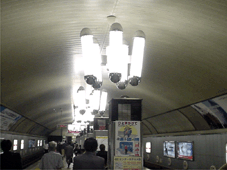
Transportation Bureau Illuminating undersurfaces
with a chandelier-style fixture is rather
inefficient. However, it is effective when
lighting up a wide area, which makes the chandeliers
perfect for the high ceilings inside the subway
complexes. When they were first put into operation,
they were the pride of
Osaka citizens, and today, they continue to
hint at the past glory of the subway system.
Next time you ride a train, take a minute
to stop and look up at the lights of the Osaka
subway with their economical and functional
design.
http://www.kotsu.city.osaka.jp/
|
|
|
|
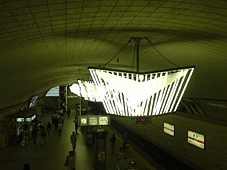
Stations
with Chandeliers
Along with the structure
of the building and the color scheme, the stations
between Umeda and Tennoji, built before the war,
were each originally designed with special lighting
fixtures. This was meant to help passengers remember
the station names and encourage familiarity with
the station. At Tennoji, this meant installing paper-lantern-style
fixtures to brightly
light the expansive platform and exquisite chandeliers
made to match the dynamically arched ceilings at
Umeda, Yodoyabashi and Shinsaibashi. |
|
|
Why Fluorescent Chandeliers?
When the subway was first
opened, incandescent lighting was used, but it wasn't
particularly durable and required many people to
maintain it. In order to provide a uniform amount
of light to illuminate the expansive station complexes
and provide a more economical source of light, in
the early 50s, a decision was made to switch to
fluorescent lighting. Compared to incandescent light,
fluorescent lights of the day were more than four
times as efficient and functioned for more than
six times as long, greatly reducing both energy
consumption and maintenance. With advances in fluorescent
lighting came improvements in illumination intensity,
and reductions in the oppressive and bleak atmosphere
in the underground complex. This in turn led to
increased safety for passengers and increased efficiency
among subway workers. |
|
|
|
|
|
|
|
|